
Statement on Landmines
October 8, 2025
Delivered by Mr. Yeshua Moser-Puangsuwan on behalf of International Campaign to Ban Landmines
80th Session of the First Committee on Disarmament and International Security - civil society segment
New York City, October 2025
Thank you, Chairperson,
I am speaking on behalf of the International Campaign to Ban Landmines, a global civil society coalition working for a world free of antipersonnel landmines and the 1997 Nobel Peace Prize Co-Laureate.
The Mine Ban Treaty remains a shining example of humanitarian disarmament — a ground-breaking instrument that, for the first time, banned a conventional weapon and set a precedent for future disarmament instruments.
Today, 166 States Parties — representing 80% of the world’s nations — are on board. We warmly welcome the Marshall Islands and Tonga this year. Over its 25-year history, the treaty has stigmatized antipersonnel mines globally, created a strong framework for their total eradication, and upheld the rights and dignity of landmine victims and survivors.
According to the Landmine Monitor, some 30 States Parties have become mine-free to date, tens of millions of stockpiled mines have been destroyed, and risk education and assistance to victims are provided at levels unimaginable before the treaty.
Yet, these hard-won gains are now under grave threat. Since its invasion of Ukraine in 2022, Russia has used antipersonnel mines on a massive scale not seen in decades. Last year the United States transferred antipersonnel mines to State Party Ukraine for the first time since 1997. Meanwhile, government forces in Myanmar have dramatically expanded their mine use, resulting in widespread casualties and displacement. We are also deeply concerned by new use reported in Iran and North Korea. The ICBL is saddened by reports of new mine use along the Cambodia–Thailand border and urges both governments to clarify the situation and swiftly clear any remaining contamination.
Non-state armed groups also continue to use improvised mines in a few countries, including Myanmar and Gaza.
All use of antipersonnel mines by anyone, under any circumstances, is unacceptable and must be condemned and halted immediately.
This year, the treaty has been shaken further by the recent notifications of withdrawal by five European countries — Estonia, Finland, Latvia, Lithuania, and Poland — citing security concerns. The ICBL condemns these short-sighted, shameful decisions and urges these states to reverse course, and not to engage in production or use of these appalling, primitive weapons.
Even more alarming, however, is Ukraine’s unilateral decision — communicated to the UN Secretary-General on 18 July 2025 — to “suspend” its obligations under the Mine Ban Convention. This action is not permitted under the treaty, nor under the Vienna Convention on the Law of Treaties, which Ukraine cited. If left unchallenged, this could set a very dangerous precedent allowing states to “pause” humanitarian obligations in wartime — precisely when they are needed most.
The ICBL calls on Ukraine to immediately retract this unlawful suspension and return to full compliance. We urge all States Parties to take a clear and united stance at the upcoming 22nd Meeting of States Parties — to affirm that suspension is impermissible and incompatible with the spirit and letter of the treaty. Silence or inaction would risk legitimizing a precedent that could unravel decades of humanitarian progress and provide leeway for halting states obligations under other disarmament and IHL treaties.
The treaty’s implementation also requires renewed attention. Clearance of contaminated land and provision of victim assistance have been insufficient, recently hindered by massive funding cuts and freezes. Donor and affected states must find the ways and resources to redouble efforts and sustain the momentum.
In parallel, we urge all the 31 remaining states to join the convention and the global fight against landmines.
Finally, while here at the First Committee, we call on all states to condemn any new use of antipersonnel mines by anyone under any circumstances and to vote in favour of the forthcoming UN General Assembly resolution on the Mine Ban Treaty.
The future of the treaty — and its humanitarian legacy — depends on the resolve of its members today. Let us act decisively to protect it and to uphold our shared vision of a world free of antipersonnel mines.
Thank you.
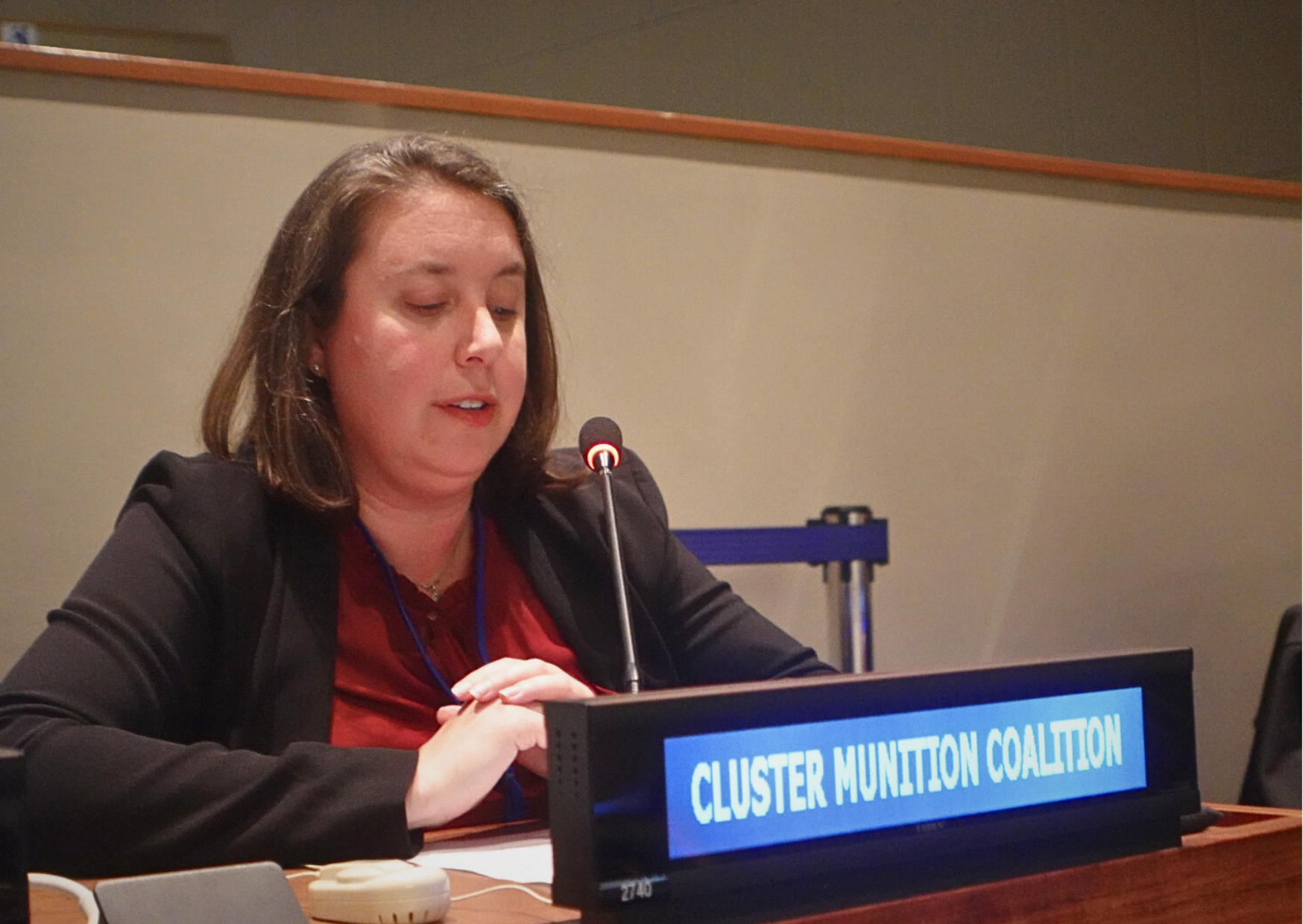
Delivered by Erin Hunt on behalf of the Cluster Munition Coalition
80th Session of the First Committee on Disarmament and International Security – civil society segment
New York City, October 2025
Thank you, Chairperson.
I speak on behalf of the Cluster Munition Coalition, a global civil society network working for a world free of cluster munitions.
The Convention on Cluster Munitions remains the only international framework for effective eradication of this abhorrent and indiscriminate weapon. It has established a powerful global norm that stigmatizes cluster munitions through the strict prohibition of their use, production, stockpiling, and transfer.
The Convention continues to stand strong, with 112 States Parties and 12 signatories. This year, we were pleased to welcome Vanuatu as its newest member. We urge all other states — particularly those that signed the Convention more than 15 years ago — to complete their ratification process without further delay, ahead of next year’s Review Conference, to be hosted by Laos.
Since its entry into force in 2010, the Convention has achieved remarkable progress on the ground. States Parties have destroyed all cluster munitions once held in their stockpiles — totaling nearly 180 million submunitions. Eleven previously affected countries have cleared all contaminated land, while others continue their determined efforts toward that goal. States Parties are also diligently implementing the Convention’s robust provisions on risk education and victim assistance.
However, these extraordinary achievements have been in recent years overshadowed by the continued use and transfers of cluster munitions, as well as by one State’s decision to withdraw from the Convention.
As reported by the Cluster Munition Monitor, cluster munitions continue to be used extensively in Ukraine by both Russia and Ukraine. New use has also been recorded in Myanmar and Syria, and Thailand appeared to have used cluster munitions during its border conflict with Cambodia this summer.
Civilians continue to represent the vast majority of victims, with children disproportionately affected — accounting for 42 percent of all casualties from cluster munition remnants in 2024. For the third consecutive year Ukraine recorded globally the highest number of casualties.
Given the grave and long-lasting humanitarian consequences these weapons inflict — both now and for decades to come — it has been deeply disheartening to witness Ukraine’s use of cluster munitions, enabled by transfers from the United States last year.
All use of cluster munitions, by anyone and under any circumstances, must be unequivocally condemned and halted immediately, along with any actions that could lead to further use — including their transfer and production.
This year the Convention faced an unprecedented, unconscionable development : Lithuania’s decision to withdraw from the Convention. This withdrawal, which took effect in March, marks the first-ever withdrawal from a humanitarian disarmament treaty.
The Cluster Munition Coalition condemns Lithuania’s short-sighted decision and urges it to reconsider. We call on Lithuania to refrain from any acquisition or production of these prohibited weapons. Having witnessed the ripple effects of one State’s actions on the resolve of others in other fora, we appeal to all States Parties to remain steadfastly committed to the Convention and to their legal obligations at all times. This Convention as any other humanitarian disarmament treaty must never be treated as a fair-weather commitment. Civilian lives and limbs are at stake.
As efforts toward universalization are more critical now than ever, we once again call on those still outside the Convention to take immediate steps to join, and thereby strengthen the protection of civilians. This includes enacting moratoria on the production, transfer, and use of cluster munitions — particularly in ongoing conflicts.
As a first and vital step, we urge all states to vote in favor of the annual UN General Assembly resolution on the Convention this year, and to encourage others to do the same.
Thank you.
Statement on Landmines
October 8, 2025

Statement on Cluster Munitions
October 8, 2025