Tonga Becomes the 166th State Party to the Mine Ban Treaty

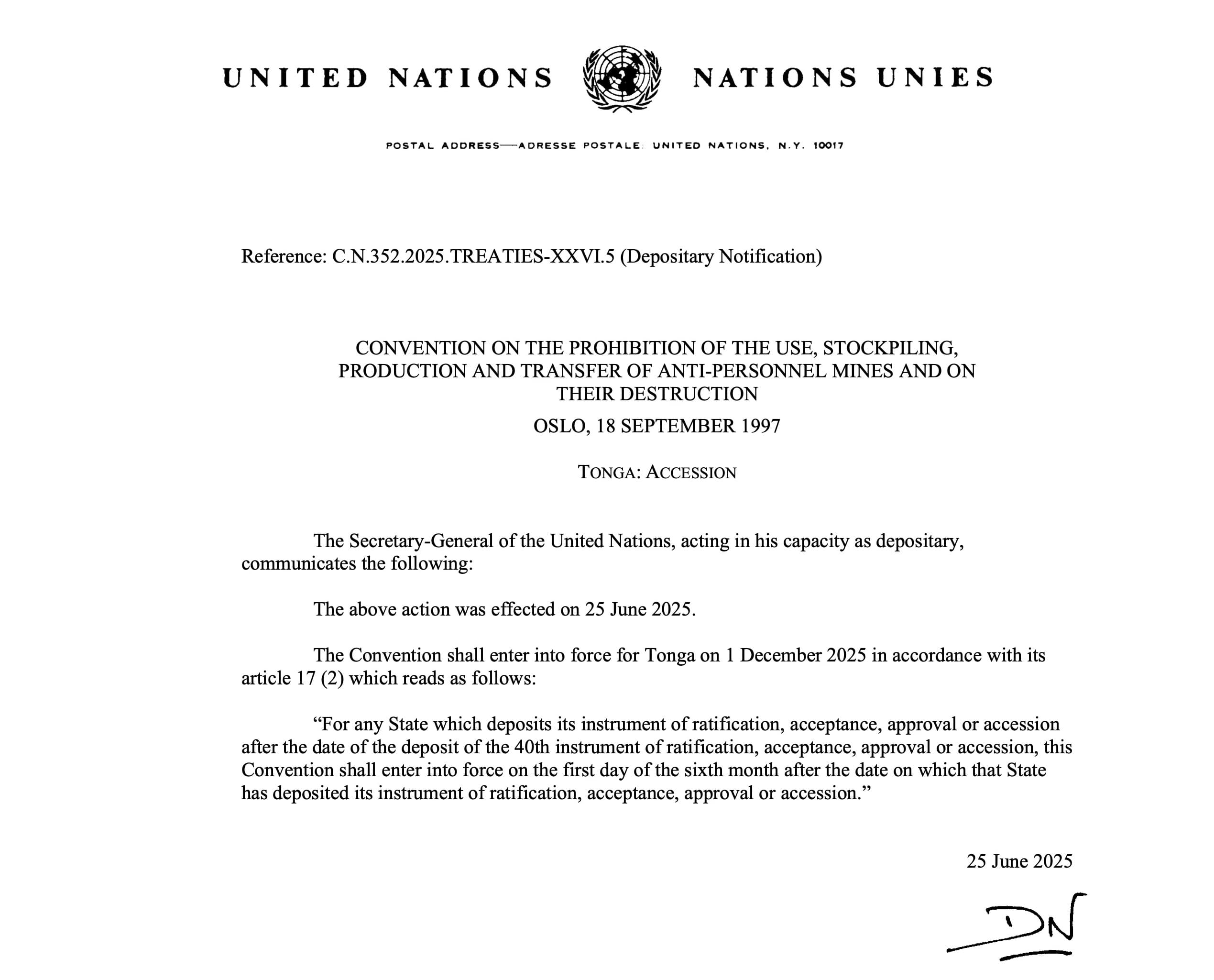
Geneva, 25 June 2025 – Tonga today deposited its instrument of accession to the 1997 Mine Ban Treaty with the United Nations Secretary-General, marking a pivotal step in Pacific-led humanitarian disarmament. This accession makes Tonga the 166th State Party to the convention, which comprehensively bans the use, production, stockpiling, and transfer of anti-personnel landmines. It is the first accession to the treaty since 2017, when Palestine and Sri Lanka joined.
The move follows decades of Tonga’s gradual alignment with the treaty’s principles. Unlike signatory states that required ratification, Tonga never formally signed the Ottawa Convention despite endorsing its humanitarian goals. Historical records indicate accession delays stemmed from resource constraints and domestic procedural hurdles, though Tonga consistently voted in favor of every annual UN General Assembly (UNGA) resolution promoting the Mine Ban Treaty since the year 2000.
Tonga’s instrument of accession, deposited on 25 June 2025, will bring the treaty into force for the Kingdom on 1 December 2025. From this date, Tonga will be fully bound by the treaty’s obligations.
Tonga has never produced, stockpiled, or transferred anti-personnel mines, aligning its past practice with the treaty’s core prohibitions. Deputy Prime Minister Hon. Dr. Taniela Fusimaiohi earlier emphasized that while Tonga faces no direct landmine threats, joining the convention reflects its "commitment to global peace initiatives." Crown Prince Tupouto’a, Minister of Foreign Affairs, championed the cause in parliamentary discussions earlier this year. Tonga’s decision bolsters the Pacific’s leadership in humanitarian disarmament and International Humanitarian Law. It follows the Marshall Islands’ ratification in March 2025, narrowing the region’s gap toward a #MineFreePacific. Only the Federated States of Micronesia remains outside the treaty.
Tonga’s accession is a welcome development at an otherwise difficult moment for the treaty. Five European states - Lithuania, Latvia, Estonia, Finland, and Poland - recently decided to withdraw from the treaty to give themselves the right to use antipersonnel mines in the face of heightened regional insecurity, threatening the global norm rejecting these indiscriminate and abhorrent weapons.
Tamar Gabelnick, Director of the International Campaign to Ban Landmines (ICBL), hailed the move:
"Tonga’s accession sends a defiant message: humanitarian norms prevail globally even as some European countries abandon them. This strengthens the treaty’s moral authority and sets a benchmark for the Pacific and the whole world.”