Cluster Munition Monitor 2025: Continued Progress Amidst New Challenges

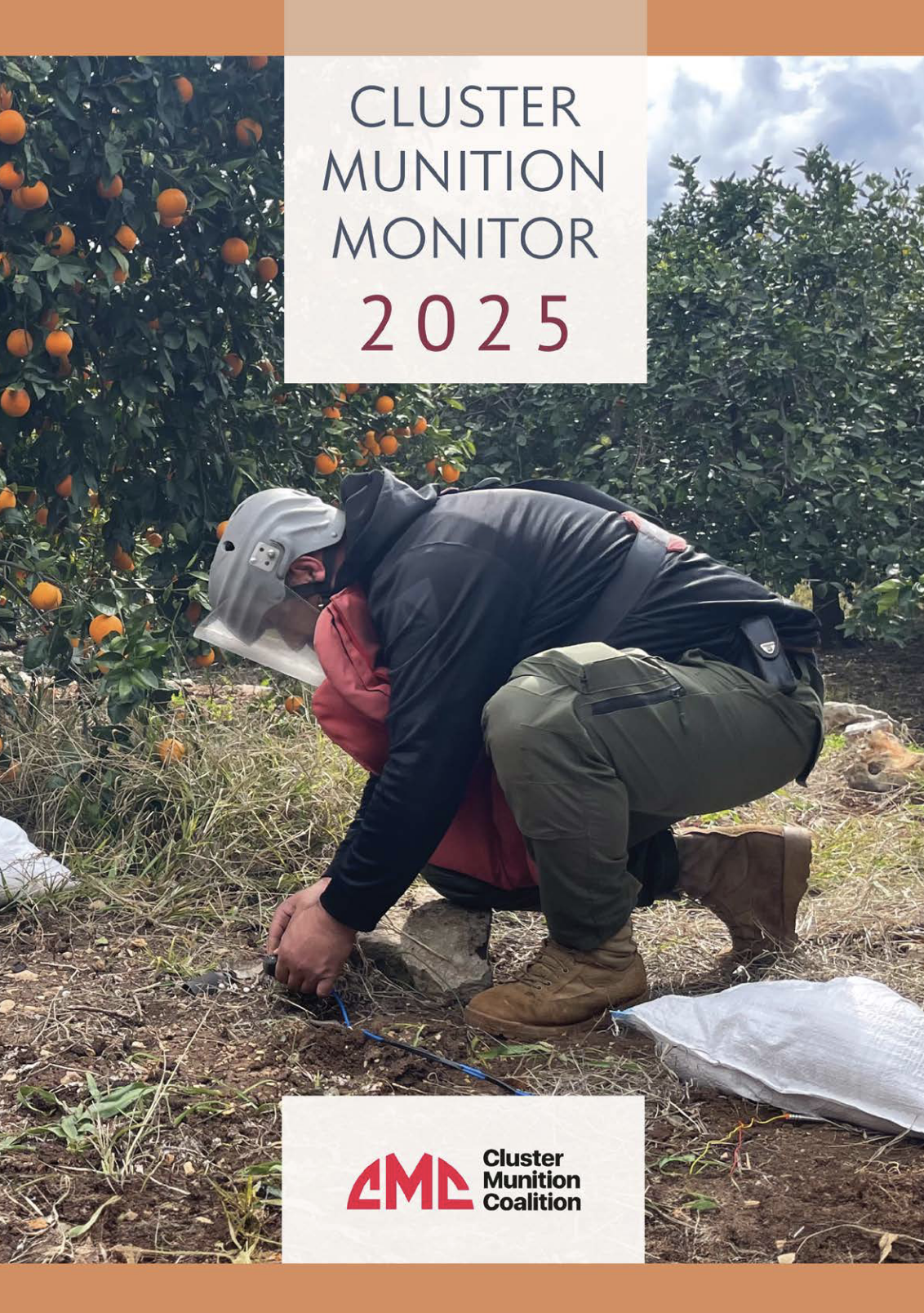
Geneva, 15 September 2025 – The 2008 convention banning cluster munitions has led to significant humanitarian progress. In 2024, as part of their commitment to clearing contaminated land, States Parties to the Convention on Cluster Munitions destroyed more cluster munition remnants than in any of the preceding five years, releasing over 100km² of land—making it safe again for use and greatly reducing the threat to civilians in those countries.
However, Cluster Munition Monitor 2025 highlights worrisome challenges to the international norm created by the convention, including Lithuania’s unprecedented withdrawal from the treaty, marking the first time a state has left a humanitarian disarmament convention, and continued use by a few states not party to the convention—Myanmar, Russia, Syria, and Ukraine.
“Cluster Munition Monitor 2025 demonstrates multiple ways the convention continues to create positive results around the world. At the same time, the growing number of civilian casualties from this indiscriminate weapon in Ukraine, as well as cluster munition attacks harming civilians in Myanmar and Syria, shows how much work remains to be done before we achieve our goal of a cluster munition-free world,” said Loren Persi Vicentic, Impact Editor of Cluster Munition Monitor 2025.
The 2025 report documents progress made in eliminating these indiscriminate weapons and in addressing the impact from past use. It also highlights some troubling setbacks that threaten the convention's norm.
With 112 countries having joined the Convention on Cluster Munitions, the treaty has established a powerful norm against these weapons, which cause unacceptable civilian harm both during conflicts and for decades after the conflicts have ended. No State Party has used, acquired, or transferred cluster munitions since joining, and States Parties have destroyed all their stockpiles, amounting to nearly 1.5 million cluster munitions containing 179 million submunitions.
The report also documents how the global stigma against cluster munitions has influenced state behavior beyond the convention’s membership. During the reporting period, two states not party—Israel and Cambodia—have protested the alleged use of cluster munitions against them.
Despite these accomplishments, cluster munitions have caused over 1,200 civilian casualties in Ukraine since Russia's full-scale invasion in February 2022, illustrating the devastating impact of these indiscriminate weapons on civilian populations.
A small number of states not party to the convention continue to use these weapons, further increasing the civilian casualty toll. Russian and Ukrainian forces both used cluster munitions throughout 2024. Myanmar Armed Forces and former Assad regime forces in Syria also used these weapons in civilian areas during the reporting period, although use in Syria appears to have ceased since Assad’s downfall. The United States transferred cluster munitions to Ukraine in at least seven separate shipments between July 2023 and October 2024, including weapons that apparently transited through State Party Germany.
In addition to continued use by states not party, Lithuania became the first country ever to withdraw from the treaty in March 2025, citing regional security concerns. This withdrawal has prompted widespread condemnation from States Parties and civil society and has raised concerns about the erosion of humanitarian disarmament norms.
“Leaving a convention banning the use of an indiscriminate weapon because of potential conflict—when the ban might need to be applied—severely undermines the norm created by the convention, with catastrophic implications for the rule of international law protecting civilians,” said Tamar Gabelnick, Director of the Cluster Munition Coalition. “We have already seen the impact this decision has had on the Mine Ban Treaty, and states should be extremely wary of a wider domino effect.”
The report also identifies critical needs in victim assistance, where structural constraints and limited resources continue to hinder adequate support for survivors of cluster munition use. While some States Parties have made improvements, access to medical care, rehabilitation, and psychosocial support remains inadequate, particularly in rural and conflict-affected areas.
The September 2025 Meeting of States Parties in Geneva will be an opportunity to discuss the findings of the report, as well as address the impact of Lithuania's withdrawal. The international community faces a crucial test of its commitment to protecting civilians and upholding the convention’s core norms.
"Seventeen years after the Convention on Cluster Munitions was adopted, we know these weapons can be eliminated," said Tamar Gabelnick. “The international community should build on the multiple successes to date by further strengthening this vital humanitarian treaty and pushing back on any attempts to weaken its norms."
The report calls for renewed commitment to universalization efforts, particularly in regions where cluster munitions continue to be used, and for increased efforts to support survivors of these indiscriminate weapons.
ENDS
For more information, contact:
Charles Bechara, ICBL-CMC Communications and Media Manager (English, French, Arabic), Tel. +41 (0) 78 323 5144, media@icblcmc.org
Éléa Boureux, Monitor Project Manager (English, French), Tel. +41 (0) 78 225 6011, monitor@icblcmc.org
Useful links:
Landmine and Cluster Munition Monitor: www.the-monitor.org
Cluster Munition Coalition: www.icblcmc.org/about-cmc
Follow The Monitor on Bluesky: minemonitor.bsky.social
Follow the CMC on Bluesky: banclusterbombs.bsky.social
Follow the ICBL-CMC on Instagram: @icbl_cmc
Follow the ICBL-CMC on LinkedIn
About the Landmine and Cluster Munition Monitor (The Monitor)
Cluster Munition Monitor 2025 is the 16th annual Monitor report by the Cluster Munition Coalition (CMC), the civil society coalition working in over 100 countries for a world without cluster munitions. The Cluster Munition Monitor 2025 report will be presented to the 13th Meeting of States Parties to the Convention on Cluster Munitions at the United Nations in Geneva on 16-19 September 2025.
Landmine and Cluster Munition Monitor is the civil society initiative providing research and monitoring for the International Campaign to Ban Landmines (ICBL) and the Cluster Munition Coalition (CMC).