Briefing paper on Myanmar Government Cluster Munition Use - Burmese
August 31, 2023
The Cluster Munition Coalition (CMC) condemns new use of cluster munitions by the Myanmar government’s armed forces and calls for an immediate end to use of this prohibited weapon. A new report by the CMC’s monitoring wing shows how Myanmar’s armed forces have used an apparently domestically produced cluster bomb in attacks in several parts of the country since 2021, including as recently as early June 2023.
“Myanmar’s production and use of cluster bombs is gravely concerning as these indiscriminate weapons primarily kill and injure civilians. There can be no justification for using them,” said Dr. Yeshua Moser-Puangsuwan, Cluster Munition Monitor researcher. “All governments should condemn this use of an internationally-banned weapon.”
Cluster munitions are delivered by artillery, rockets, missiles, and aircraft. They open in mid-air and disperse dozens or hundreds of submunitions, also called bomblets, over a wide area. Many submunitions fail to explode on initial impact, leaving duds that can indiscriminately wound and kill, like landmines, for years until they are cleared and destroyed. A total of 123 countries have prohibited the weapon under the 2008 Convention on Cluster Munitions, but not Myanmar.
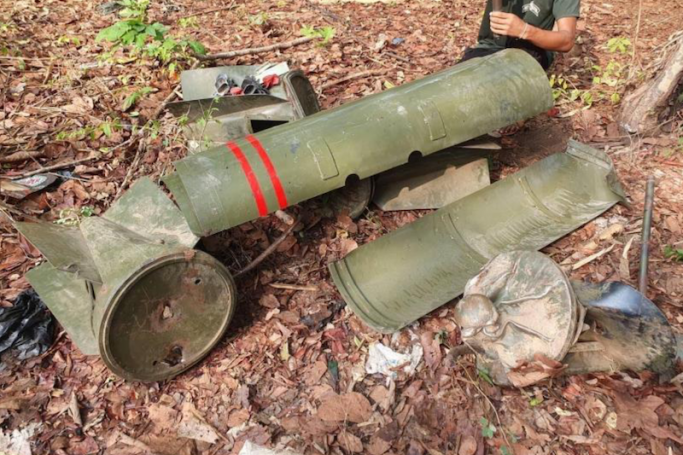
Cluster Munition Monitor has reviewed photographs showing the remnants of cluster bombs used in attacks by the Myanmar Air Force in Chin, Kayah, Kayin, and Shan states over the past 13 months. The most recent known cluster bomb attack by the Myanmar Air Force damaged a school in Kedong village tract in Kawkareik township, Kayin/Karen state on 6 June 2023. Another attack in Mindat township, Chin state in April 2023 also involved cluster bomb use. Remnants of this same type of cluster bomb were previously found in the same township after a July 2022 air attack that wounded 13 civilians, according to Amnesty International.
These attacks are part of an internal conflict that has intensified in recent months in both northwest and southeast Myanmar, resulting in civilian casualties, widespread destruction of homes and other civilian objects, and displacing people. The conflict has also been characterized by extensive new use of antipersonnel landmines by all parties.
The cluster bombs used by the Air Force look similar to other products made by Myanmar’s state-owned weapons production facility “KaPaSa” or Defence Products Industries of Myanmar, but there are no markings on the bomb remnants that show where they were manufactured or assembled.
The weapon consists of a 120mm mortar projectile with a plastic arming vane that is attached to an impact fuze that detonates each submunition on contact. Each cluster bomb has space for 12 mortar projectiles or submunitions on an internal frame. This weapon appears to meet the definition of a cluster munition under the Convention on Cluster Munitions, which prohibits a “conventional munition that is designed to disperse or release explosive submunitions each weighing less than 20 kilograms each.”
Myanmar is not known to have produced or used cluster munitions previously, although a rudimentary cluster munition adaptor was documented a decade ago. (See Cluster Munition Monitor 2013).
The Cluster Munition Monitor has asked Myanmar's Ministry of Defence to confirm or deny its production and use of cluster bombs. No response was received as of time of publication.
At the United Nations General Assembly in November 2019, Myanmar said that it could not join the convention until a nationwide peace agreement is in place. In 2009, a Myanmar government official told a regional meeting that its forces “do not use cluster munitions.”
Ends.
Briefing paper on Myanmar Government Cluster Munition Use - Burmese
August 31, 2023
Briefing paper on Myanmar Government Cluster Munition Use - English
August 31, 2023
Statement - Burmese
August 31, 2023
Statement - English
August 31, 2023